
Mental gymnastics first thing in the morning keeps the doctor away . . . well, at least those obsessive familial loops.
What do I mean by “obsessive familial loops?” Oh, you know. Waking out of deep slumber and a dream where I couldn’t remember someone’s name standing right next to me as we watched a play about Uzbekistan in an uncomfortable hotel lobby, and then upon my eyes fluttering open and seeing first light, experiencing the first conscious awareness of a brand new day, I lurch into a memory of when my father laughed at my attempts to drive a rented Mustang up his icy driveway in Northern Michigan on a Christmas Day (and yes, I never did make it up the driveway, had to leave the rented Mustang in the street, as he laughed and laughed, shaking his head as he walked away); and of course, right then and there I’m reliving it. Yeah, that sort of obsessive familial loop. Great for jumping through and tumbling . . . over and over.

Cue Edvard Munch (1893). Monday morning. Wake up at 5am. Shower. Brush teeth. Brew coffee. Open laptop. Play Bach’s Musical Offering performed by Kammerakademie Potsdam. GEB open on my lap. I’m reading Hofstadter’s words concerning the famous May evening in Potsdam in 1747 when “old Bach” visited a concert organised by Frederick the Great, King of Prussia (typical of this very musical of monarchs). Brought before the King to try out the latest in fortepianos, Old Bach eventually asked the avid flutist and composer for a “subject for a Fugue” also known as the “royal theme.” This is all a bit tricky—sipping coffee, typing, listening,
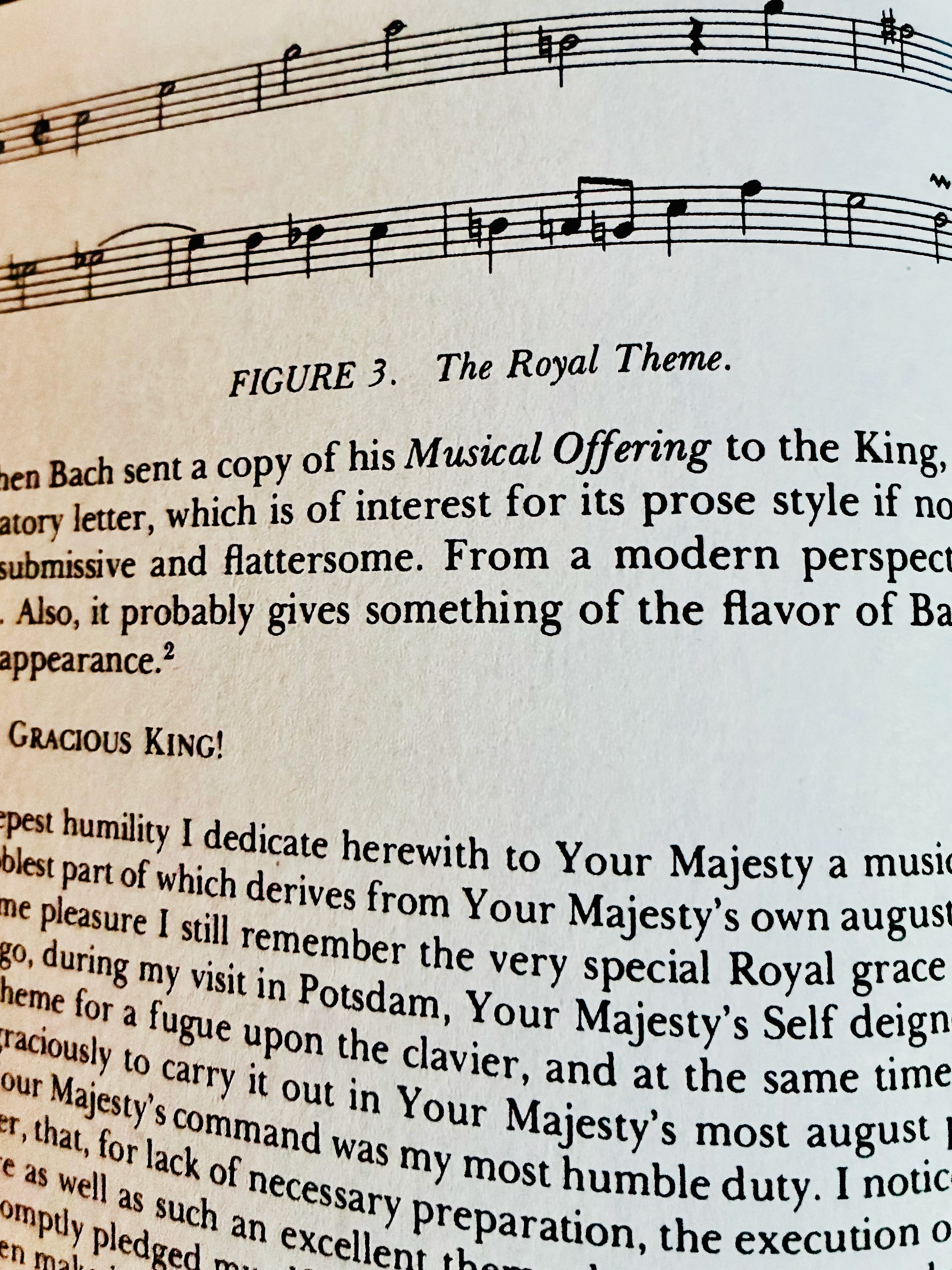
reading, thinking—but I’m an early morning circus performer. Oboe, horn, cornet, the rare piccolo trumpet and a scattering of percussion ring out the opening movement of Bach’s Musical Offering, “Ricercar a tre voici,” which is a meticulous development of the King’s royal theme originally for harpsichord. Which makes this an appropriate moment to consider what calls John Robert Harvey to Bach, whether it’s 1979 or 2026. For Harvey, Bach’s melodic line immediately sails into the coiled Nautilus shell of my ear vibrating all my little bones as tens of thousands of hairy cells

light up the house, then loop and labyrinth neuron by neuron all the way to the cerebral cortex where Bach’s melodic line, counterpoint, canon, fugue, ricercar, augmentation circles and rise in perpetuum, then falls and begins all the sonatas, partitas, suites, gavottes again. Quite the acrobat, quite the tumbler. Bach. Harvey. It’s this combination of voices that draws me forth. Pitch and dynamics. Forwards and backwards. Up and down. Dopamine dancing my body. Twists and turns. Swaying head and neck. Rolling shoulders and hips. Lunging legs and feet to all the thinking . . . and that’s exactly what all of this is . . . thinking. When Bach’s notes sound key and pedal, bow and string, mouthpiece and bell—round progressions into flourishes and further explorations of coasts, marshes, forests and mountains—then I think! And maybe it’s 1544 and I’m sailing into a New World which is actually someplace else’s and someone else’s, and really it’s 2026 or 1979; but never mind time or place, the most important discovery of waking up with Gödel, Escher Bach is that I think. And in thinking, leap and tumble joyously into a blue, bright morning. Think!
