
In 1979 or was it 1980, my grandparents took me out for a monthly trip to the local bookstore where they would purchase a tome of my choosing. Maybe B. Dalton’s booksellers or Waldenbooks. Either at Oakland Mall or Somerset Mall in Troy, Michigan. This particular day I saw Gödel, Escher, Bach: an Eternal Golden Braid by Douglass R. Hofstadter on a display stand. I knew nothing of Gödel, started flipping through the pages and discovered the prints of M.C. Escher, but I certainly knew Bach and that’s what drew me over in the first place. My grandmother did her best to school me in playing the piano, and though practicing never took hold of me, I did love playing Bach’s Minuet in G.

I decided this was my choice and my bemused grandparents dutifully bought it for me. Consider M.C. Escher’s Hand with Reflecting Globe or Self-portrait. (1935).

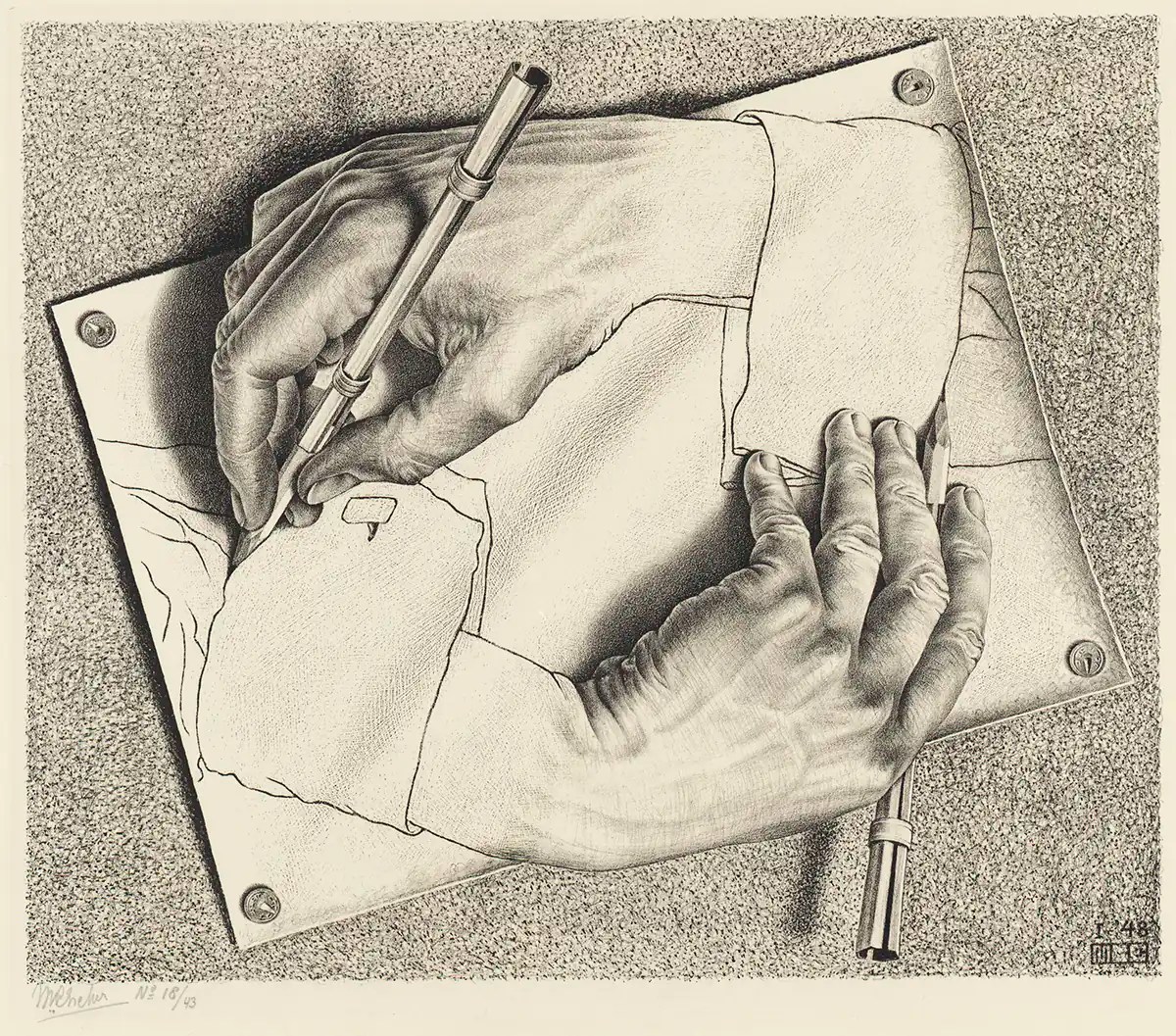
Which is an example of a strange loop as defined by Hofstadter. Look. A hand holds a glass sphere. The sphere reflects the hand, the person (M.C. Escher) connected to the hand, and the room the artist sits within. Appearance without and within the glass sphere, and so we have self-reference. Observer and observed blur, hence a tangled hierarchy which is another term that Hofstadter uses for a strange loop. Such as Drawing Hands (1948).
Years went by, but I just couldn’t crack the code. Sure, I understood the Epimenides Paradox which offers the philosopher Epimenides from Crete stating “All Cretans are liars.” Which if I accept as true, then immediately I think it is false. What to do? The trickiness of language had been clear to me for a while. I loved all the language games in Alice’s Adventures in Wonderland and Through the Looking-Glass, especially “Advice from a Caterpillar.”
“Who are you? said the Caterpillar. This was no an encouraging opening for a conversation. Alice replied, rather shyly, “I–I hardly know, sir, just at present –at least I know who I was when I got up this morning, but I think I must have been changed several times since then.” “What to you mean by that?” said the Caterpillar sternly, “Explain yourself!”

“Explain yourself.” How often I heard that growing up. Apparently, I often acted in such a way that the adults around me needed to ask such a difficult and obtuse question. Rarely did I offer a sufficient explanation. But the math of Euclid’s proof, of Gödel’s theorem, of the Circle of Fifths, of Bach’s Endlessly Rising Canon from The Musical Offering, of Georg Cantor’s theory of different types of infinities proved quite beyond me then, though I loved to hear Bach’s counterpoint, loved to get lost in Escher’s ascending and descending stairs. Eventually, the book fell away, not making one of my many “pack up and move” excursions.

Time passes. Like a bubble in glass moving infinitely slow over a thousand years. All “timey-wimey” as the 10th Doctor famously stated.
People assume that time is a strict progression of cause to effect, but actually, from a non-linear, non-subjective viewpoint, it’s more like a big ball of wibbly-wobbly… timey-wimey… stuff.
In 2026, I’m living in the small neighbourhood of Finntorp, Sweden just outside Stockholm. It’s winter.
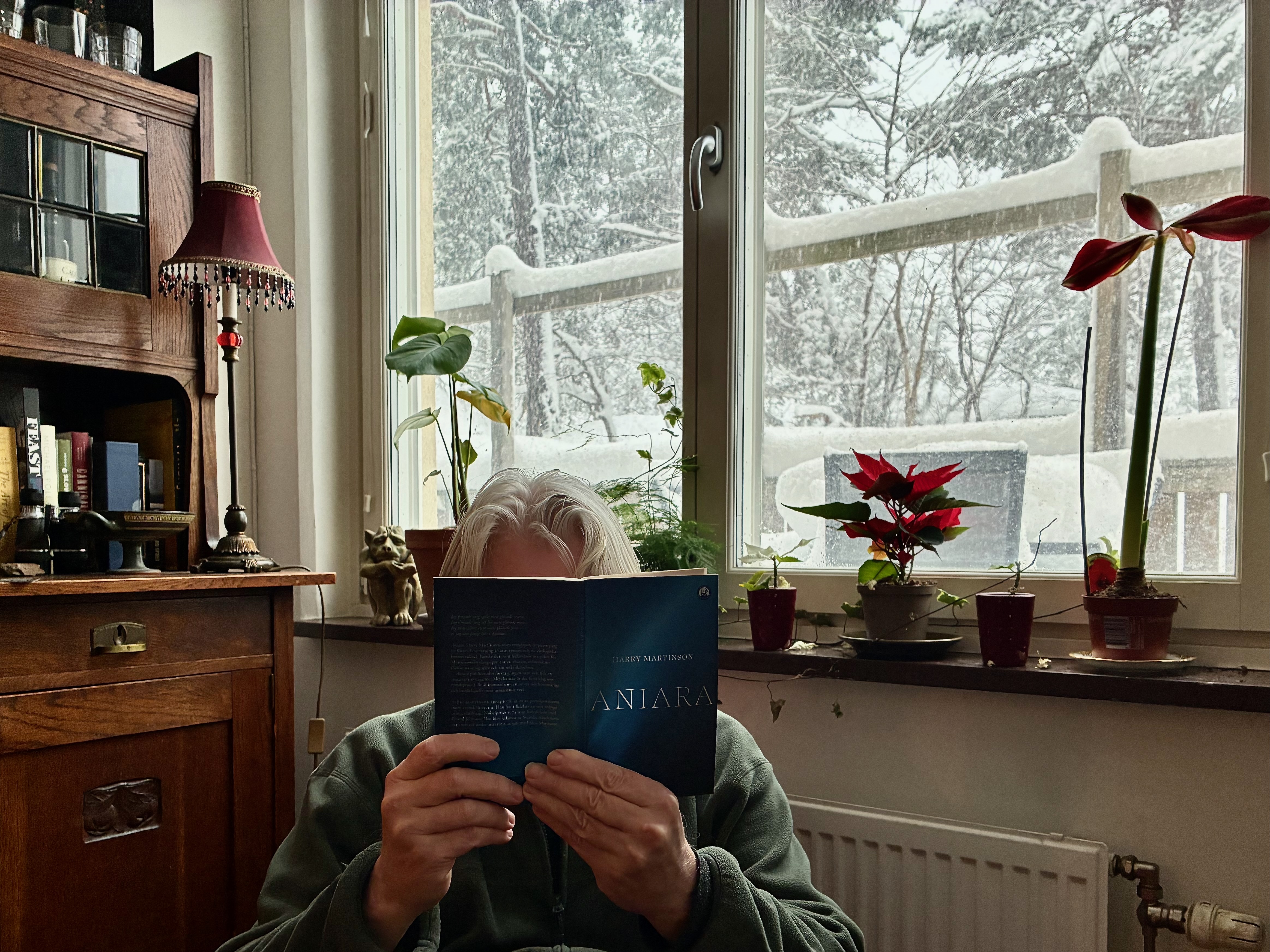
I’m reading Harry Martinson’s Aniara (1956) a novella-sized poem about a spaceship (named Aniara) of would be colonists heading for Mars who are knocked off course by an asteroid, and thereby set on an endless voyage into the depths of space when I came across the phrase
En talmängdsfilosof och mystiker / av aleftalens skola which I translated as “a philosopher of mathematical infinity and mystic of the school of aleph numbers.”
In the poem, this particular “number-set philosopher” approaches the pilot of the spaceship with mathematical formulas attempting to predict the frequency of miracles in the cosmos. Why? Why approach the pilot of a spaceship with set-theories concerning miracles? Well, this particular pilot named Isagel is herself a “talmändsfilosof” and loves to explore mathematical concepts to infinity and beyond. Also, because space debris damaged the ship’s nuclear reactor and the captain had to order the dumping of nuclear fuel in order to prevent an explosion . . . the Aniara drifts through time and space, seemingly ending the practical duties and responsibilities of a pilot.

Of course, the colonists turned trapped-passengers to nowhere freak out. So, if mathematical grace by divine intervention holds out hope of some sort of rescue . . . why not? Needless to say, there appears to be no difference between a miracle and an accident in the universe. Mathematically stated.
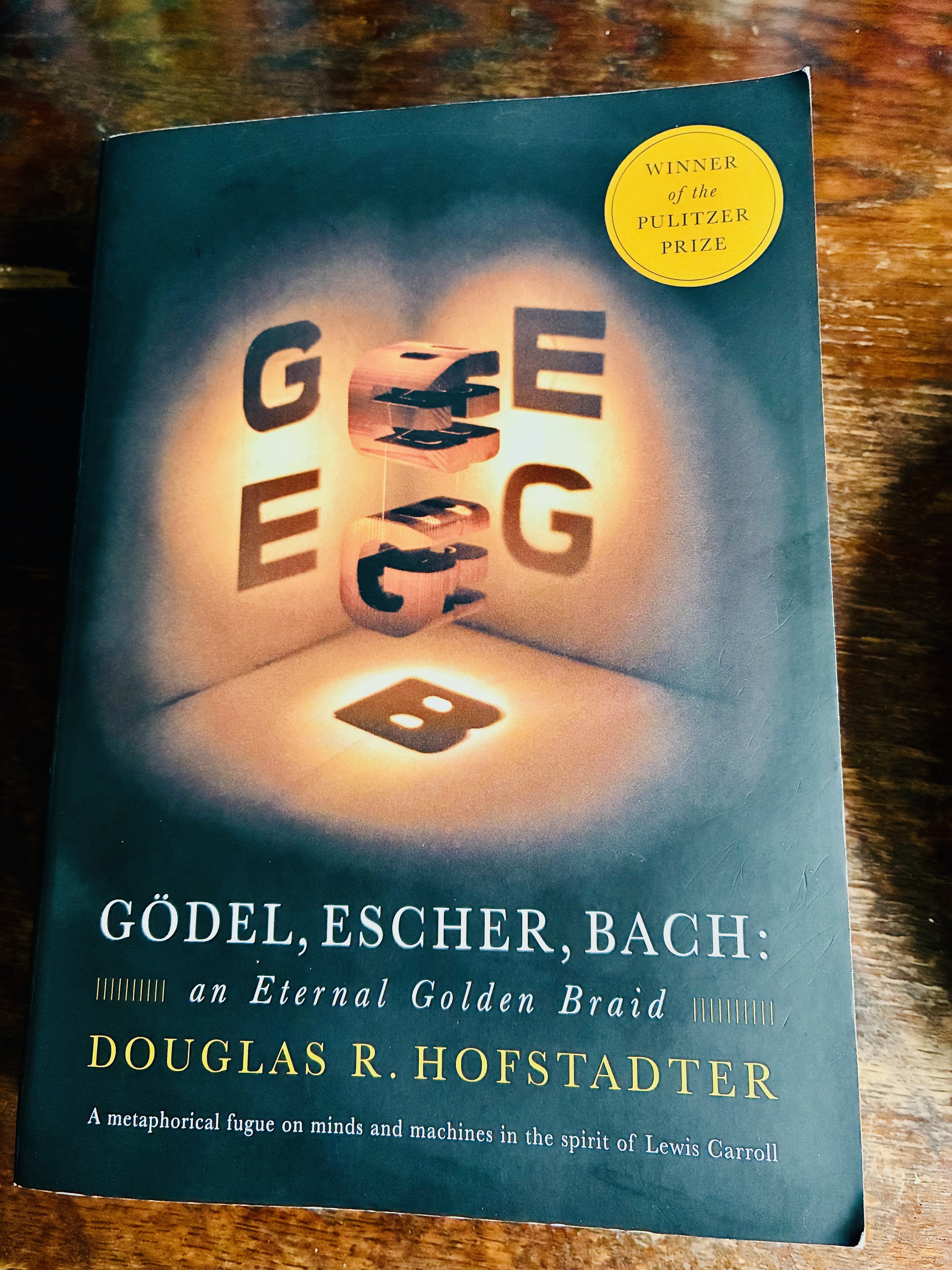
The gears of memory began grinding away. What was so familiar to me about a”philosopher of mathematical infinity” or as it also could be translated “a number-group philosopher” or “set theorist”? Also, why did all this thinking about numbers, logic, equations remind me of Bach? What about slipping in and out of planes of existence only to return to the beginning like so much Escher? And then, through the looking glass, with a nudge from a caterpillar I placed the equals sign and ordered my new copy of GEB.
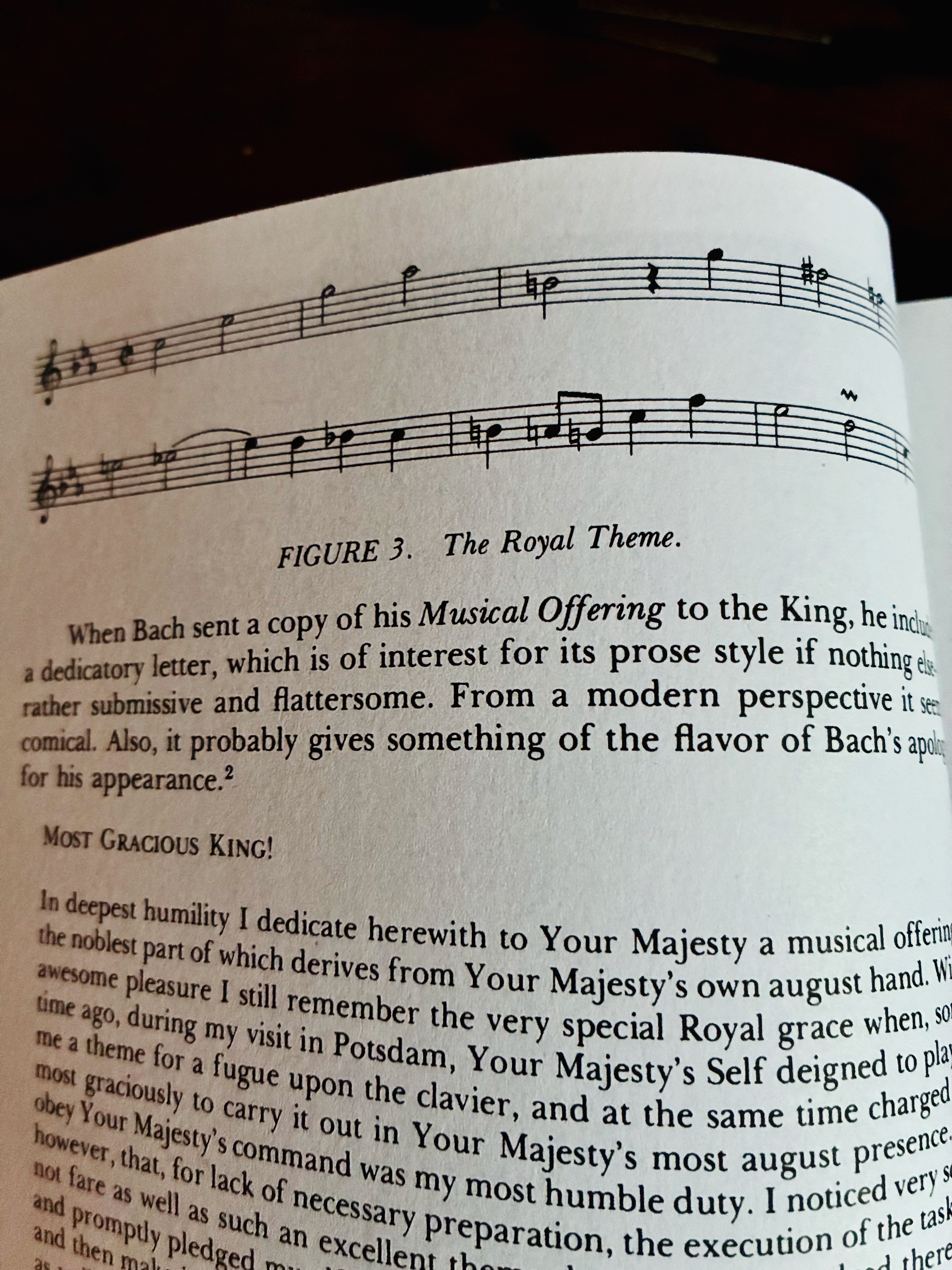
I’m reading Hofstadter’s words concerning the famous May evening in Potsdam in 1747 when “old Bach” visited a concert organised by Frederick the Great, King of Prussia (typical of this very musical of monarchs). Brought before the King to try out the latest in fortepianos, Old Bach eventually asked the avid flutist and composer for a “subject for a Fugue” also known as the “royal theme.”
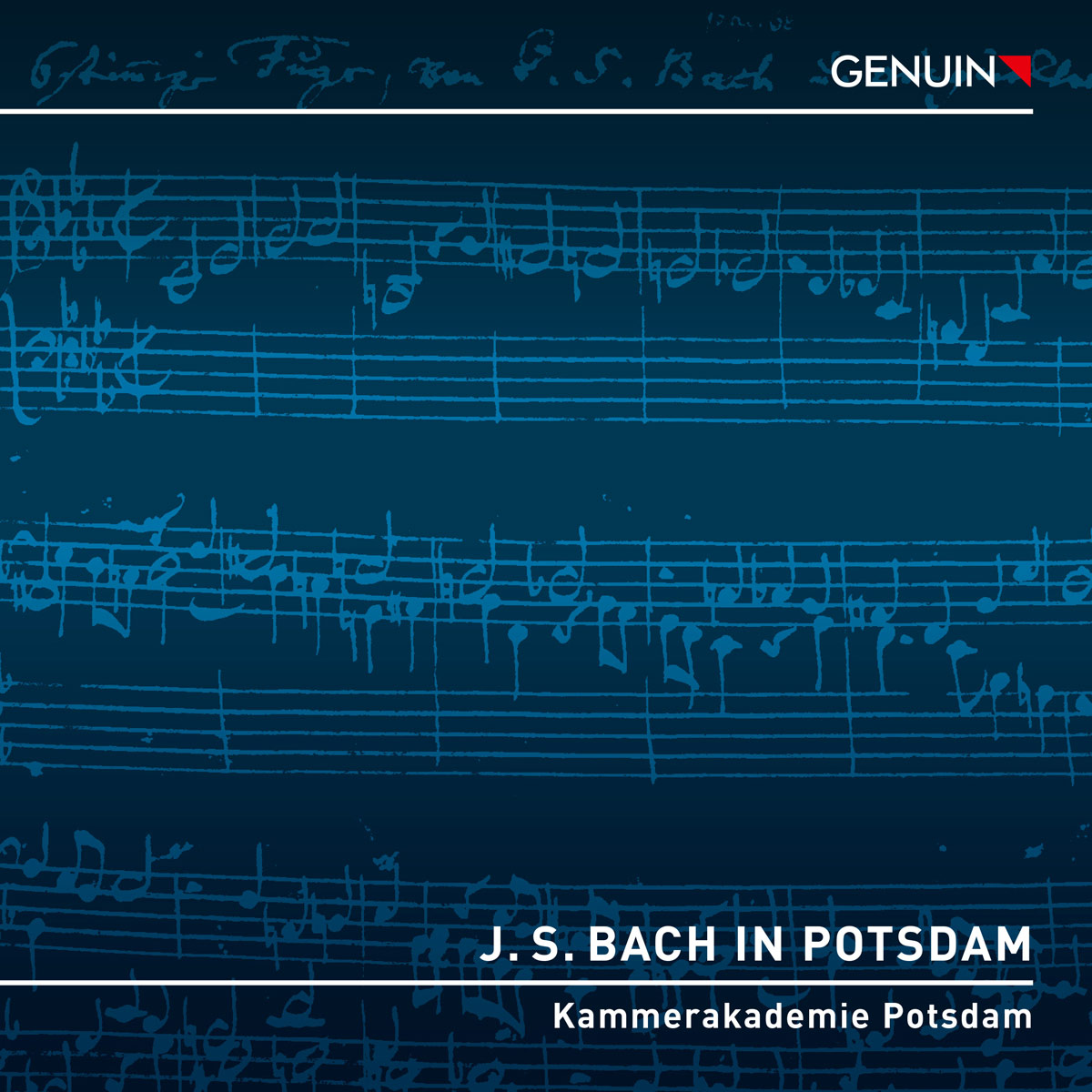
So, I’m listening to Kammerakademie Potsdam perform the opening movement of Bach’s Musical Offering, “Ricercar a tre voici,” which is a meticulous development of the King’s royal theme originally for harpsichord. This is a notable transcription featuring oboe, horn, cornet, the rare use of a piccolo trumpet (at least with Bach) and a scattering of percussion. This arrangement by the principal oboist Jan Böttcher caught my attention by mixing the somber opening melody with a playfulness and even “dance-like atmosphere” maybe suggesting an Astor Piazolla tango (of which Kammerakademie Postsdam has performed excerpts from Piazolla’s Four Seasons of Buenos Aires.)
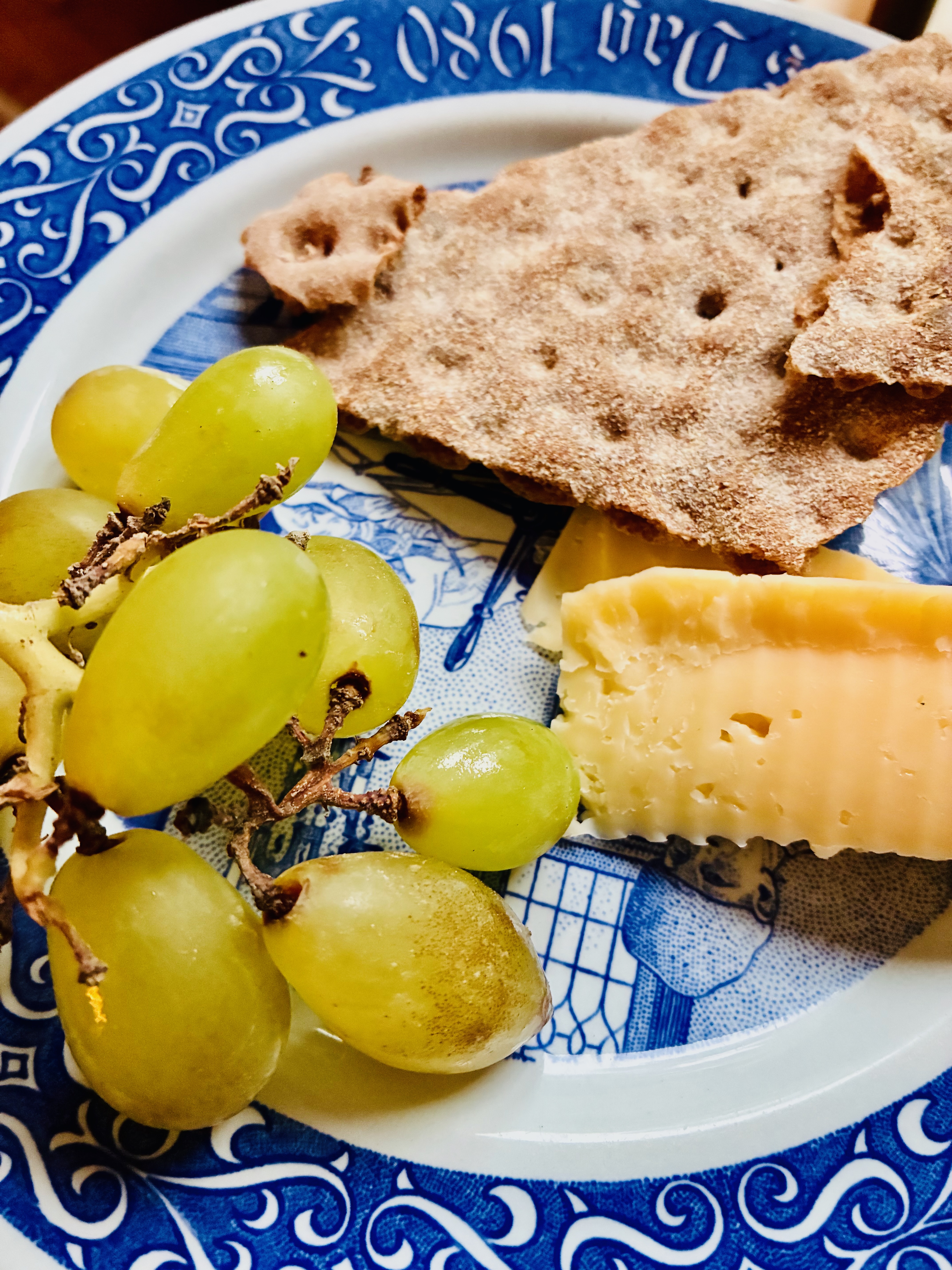
Meanwhile, I nibble on grapes, Prästost (“Priest” cheese which is creamy and tangy) and knäckebröd (Swedish crispbread) and muse as my seventeen-year old self meets my sixty-three year old present as we once again turn the pages of GEB.
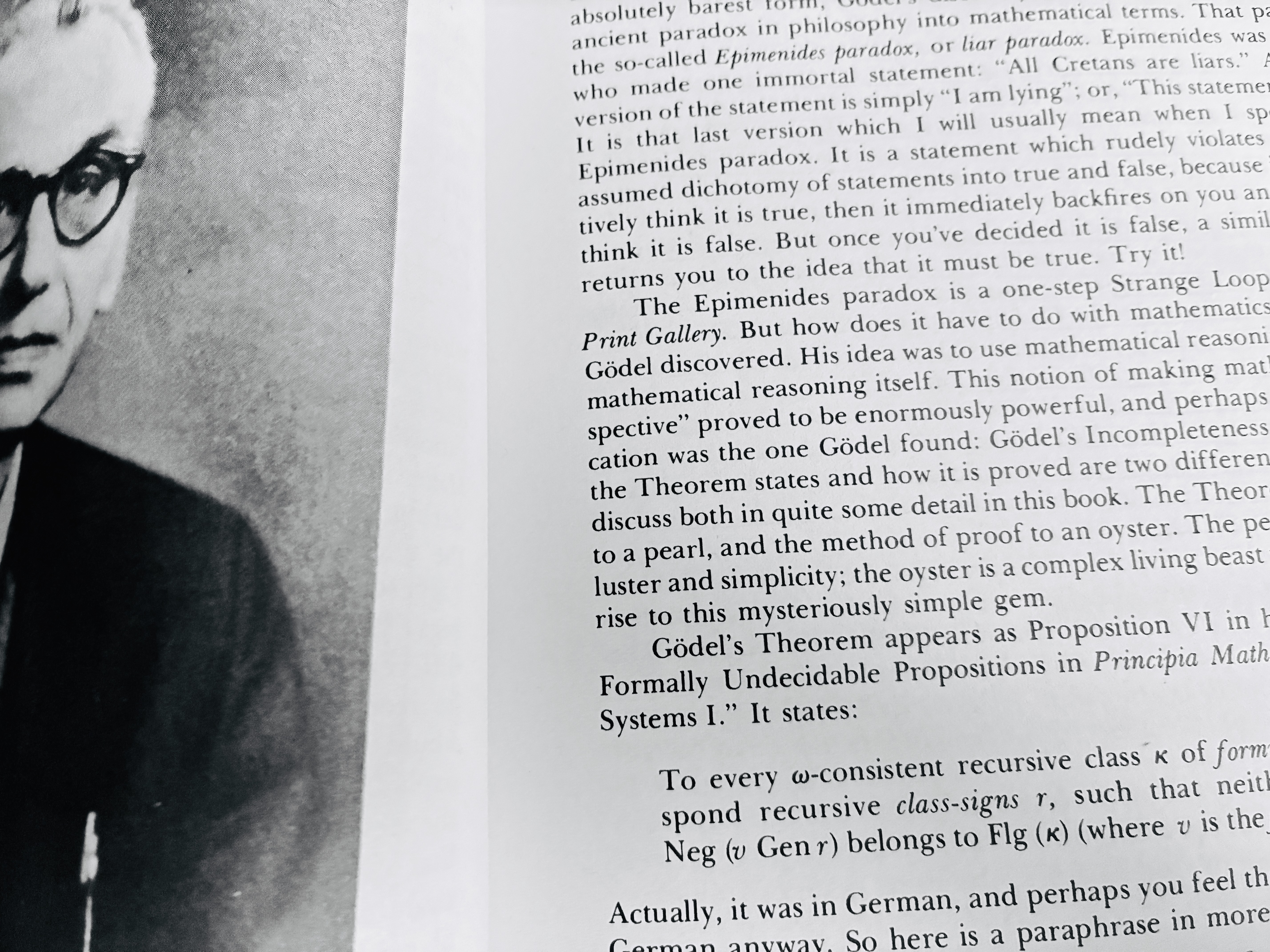
Where will this lead? Well, I envision a journey ever moving forward page by page, but also quite recursive as in every so often looping back to where I’ve been, getting all tangled up in blue, and in this way, further shaping this “I,” this “self” you read displayed on this page / screen. Over and over, which is how I start myself back up again each morning. And what about you? dear reader somewhere out there. Are you a strange loop? A Bachian? Escherian? Gödelian? An Aniaran drifting through time and space?