
Introspection. That’s a tricky one. When I sat in my bedroom in my parent’s house on a street called Winchester in a subdivision named Sylvan Glen in a suburb named Troy in southeastern Michigan, a suburb which fashioned itself as the “City of Tomorrow . . . Today,” in the year nineteen-hundred and seventy-nine did I believe at sixteen years-old that introspection had to do with deep-thinking, and back then, did I consider myself prone and prey to deep thoughts–who and what are my parents? and was I adopted? How many question marks is that? Of course, this is part of the problem, how is it possible that I write “believe” about viewing a past version of myself, and why in the world do I make that distinction? Am I not who I was? And is that a deep thought?

In my junior year of high school I read Albert Camus’ The Stranger. I could say that this is an example of my deep, existential thinking, but really the whole novel was a puzzle to me. Meursault clearly does not love his mother and decides not to abide by the conventions of her funeral. Fine. At that age, let’s say my relationship with my mother had its arguments, tears, and silences but would I not cry at her funeral (eventually I did)? Of course, I was reading the main character as an extension of myself. Fallacy. As I read on and drank in Meursault’s indifference to the world, I felt a certain freedom if not joy in discarding the people and education that I was told should matter to me, but that I believed to actually to be a great imposition upon me if not a complete fraud. And yet, as I read on, I continually wanted to fix Meursault so that he did cry or at least make a show of crying at his mother’s funeral, that he really did love his girlfriend Marie, that he certainly would never shoot a stranger, and if he did he just wouldn’t shoot four more bullets into the body . . . and then not express contrition in order to save himself from execution. So puzzled, yes I was puzzled. Back to Gödel. His Incompleteness Theorem.
To every ω-consistent recursive class κ of formulae there correspond recursive class-signs r, such that neither vGen r nor (\text{Neg}(v\text{Gen }r)) belongs to Flg(κ) (where v is the free variable of r).
Hofstadter writes, “Actually, it was in German, and perhaps you feel that it might as well be in German anyway. So here is a paraphrase in more normal English, “All consistent axiomatic formulations of number theory include undecidable propositions.”

Hofstadter calls this a strange loop and a pearl. If this pearl reads like Epimenides’ Paradox, then that’s because the similarity resides in the language. As far as the proof or innards of the oyster, well let’s give it a go. Hofstadter writes,
Gödel had the insight that a statement of number theory could be about a statement of number theory (possibly even itself), if only numbers could somehow stand for statements. The idea of a code, in other words, is at the heart of his construction. In the Gödel Code, usually called “Gödel-numbering”, numbers are made to stand for symbols and sequences of symbols. That way, each statement of number theory, being a sequence of specialised symbols, acquires a Gödel number, something like a telephone number or a license plate, by which it can be referred to. And this coding trick enables statements of number theory to be understood on two different levels: as statements of number theory, and also as statements about statements of number theory.

Before Gödel, math was used to talk about things like counting birds in a painting by Hieronymus Bosch, such as The Garden of Earthly Delights (1490-1510). Which of course, one can do even though some of the birds get a bit smudgy-wudgy. Gödel realised that if he assigned a specific number to every mathematical symbol, a math equation could be used to have a conversation about other math equations. So, he assigns a whole number to a mathematical symbol . . . let’s say 1 to ~ (meaning “not”) or 3 to ⊃ (meaning “if. . .then”). Then, he assigns prime numbers to stand in for the whole numbers: followed by the first two prime numbers (2 and 3) as the placeholders for our sequence: Slot 1 (for ~ ): Prime number 2 / Slot 2 (for ⊃): Prime number 3. He raises each prime number to the power of its corresponding whole number code and multiplies them together: Gödel number = 2¹ × 3³, Gödel number 2 × 27=54. And so, the number 54 means ~ ⊃. What about an Hieronymus Bosch tree?

In the iconography of The Garden of Earthly Delights, the fecund tree in the left panel, stationed next to a recumbent Adam is the Tree of Life. Ah eternity, ah everlasting existence! Watch out for those flaming swords!! This Tree of Life appears to be based on graphic engravings such as Martin Schongauer’s 15th century print The Flight into Egypt as well as drawings of dragon trees in contemporary travel logs. The dragon tree is native to a group of volcanic archipelagos in the North Atlantic, off the western coast of Europe and North Africa. If you turn it upside down, it may bear a similarity to a Parse Tree for the sentence, “Douglas Hofstadter sleeps at night.”
         [ S ]
          /     \
         /       \
     [ NP ]     [ VP ]
       |       /      \
       |      /        \
    [ NNP ] [ V ]     [ PP ]

       |      |       /    \
       |      |      /      \
       |      |   [ P ]    [ NP ]
       |      |     |        |
       |      |     |      [ N ]
       |      |     |        |
    "Douglas  "sleeps" "at"   "night"
   Hofstadter"

Which on the face of it, provides a symbolic logic in order to think about sentences. Now that we can see the grammatical structure of the sentence we may begin to understand its inner workings according to the rules. The sentence (root node) roots or branches (which way is up, which way is down?) into a Noun Phrase and a Verb Phrase–phrase built around a noun and the action of the sentence. From there we move to a singular proper noun with the verb phrase dividing into the verb and the prepositional phrase, and then the prepositional phrase divides into a preposition and noun like a nest or a root mat.

Matted roots seem to me as so much the actual intertwinement of life and death, soil and cosmos, wherein it is really almost impossible to disentangle the whole knotty puzzle. If we were to “Gödel-number” this exact Parse Tree, a computer system would assign a specific integer code to every single tag above (e.g., S=1, NP=2, VP=3, and so on) and use prime factorisation to mathematically lock this exact geometric nest or mat into a decodable number. And so, numbers and letters, sets and words contemplate their existence, or so it seems. Wait a minute. What about the Epimenides Paradox? Hofstadter writes,
Once Godel had invented this coding scheme, he had to work out in detail a way of transporting the Epimenides paradox into a number theoretical formalism. His final transplant of Epimenides did not say, “This statement of number theory is false,” but rather, “This statement of number theory does not have any proof”.
And so an Epimenides sentence creates a paradox since it is neither true nor false, and a Gödel sentence is paradoxical because unprovable but true. I’ve left out some details like the Principia Mathematica by Bertrand Russell and Alfred North Whitehead which is certainly the focus of Gödel numbering, but I hope the deep thinking I’ve afforded (if it is deep thinking) at least suggests a thinking about thinking or non-thinking or can math contemplate its own psychosis. Which brings us back to Troy.
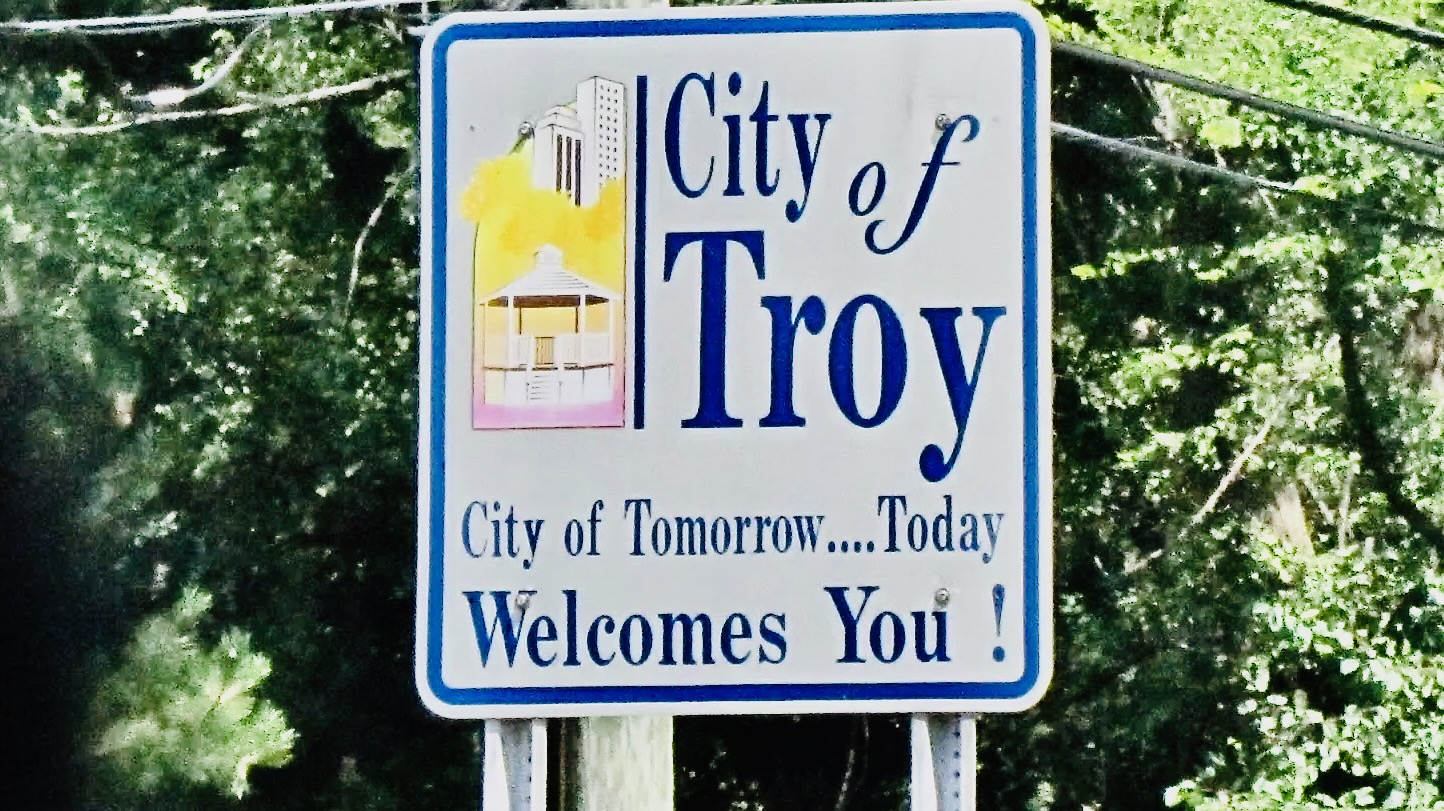
Is time travel a derivative of introspection? Is adolescence bound to any existential crisis? At sixty-three years of ageing are my jottings indications of contemplation, self-induced therapy, the examined life? Why The Stranger? Why Gödel, Escher, Bach? Why am I looping back to Troy, Michigan circa late 70s? Has a new instance of myself been called forward? Am I self-generative? Is this post an example of my own recursive self-improvement (RSI)? Do I suffer from hypergraphia? Is this somehow leading to AI?